
Why outerwear care is different
A coat is worn over everything else, which means it meets rain, exhaust, hedgerows and car seats but almost never meets your skin directly. It gets dirty on the outside and stays clean on the inside. That is why the honest answer for most of our coats is: clean far less often than you think, but maintain constantly.
Wool coats and jackets
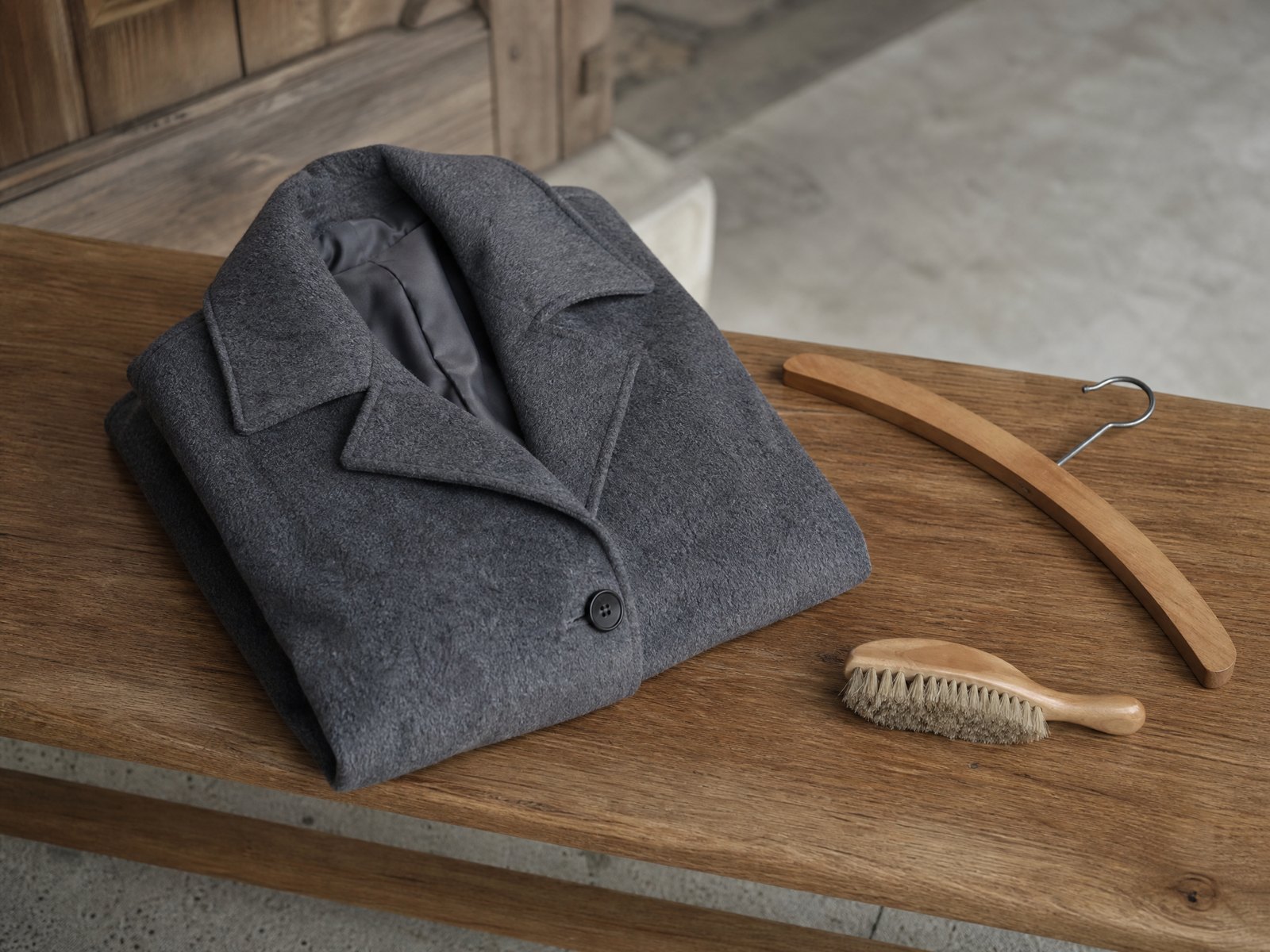
Dry clean only. Wool coating, melton, doeskin and boiled wool will felt and shrink irreversibly in water and agitation. A good coat needs dry cleaning once or twice a season at most.
- After each wear — hang on a broad, shaped hanger, never a wire one. Wool needs 24 hours to release the creases from a day’s wear and the moisture it has absorbed from the air.
- Brushing — a soft natural-bristle clothes brush, always in one direction, following the nap. This lifts dust out of the weave and is the single most effective thing you can do for a wool coat’s appearance.
- Wet through — hang away from radiators and let it dry at room temperature. Direct heat shrinks and hardens wool fibre.
- Pilling — normal at friction points such as under the arms and where a bag strap sits. Remove with a comb or a pilling stone, never by pulling.
- Creases — steam from a distance of about 20cm, or hang the coat in a bathroom while you shower. Do not press the face of boiled wool directly; it flattens the surface permanently.
- Small marks — blot with a barely damp cloth and no detergent. Work from the outside of the mark inwards.
Cotton gabardine trench coats
Cotton trenches are the most forgiving thing we make. Most can be machine washed; the product page confirms which.
- Close the buttons, fasten the belt in the buckle so it does not thrash, and wash cold at 30°C on a gentle cycle.
- Use a mild non-biological liquid detergent. Enzymes in biological powders attack cotton finishes over time.
- No fabric softener — it coats the fibre and reduces the water-repellent behaviour of a tight gabardine weave.
- Do not tumble dry. Hang damp on a shaped hanger and pull the seams straight with your fingers while wet; the coat will dry into shape.
- Iron on the reverse while slightly damp, warm setting, and press the collar and cuffs last.
- The water-repellent finish is mechanical, not waxed. It fades after many washes. A spray-on fluorocarbon-free reproofer restores it.
Suede jackets
Specialist leather clean only. Suede is a napped hide and water is its enemy in volume, though a light shower does no lasting harm.
- New jacket — treat with a suede protector spray before first wear. Test on an inside seam allowance first, hold the can 25cm away, apply thin even passes, dry for four hours.
- Caught in rain — shake off standing water, hang at room temperature away from heat, and once fully dry brush the nap back up with a rubber or brass suede brush.
- Marks — a suede eraser lifts most dry marks. Follow with a brush to restore direction.
- Grease — cover the mark with cornflour, leave overnight, brush out. Never use water on grease.
- Storage — a breathable cotton garment bag with room around it. Plastic traps moisture and dries the hide.
- Never machine wash, never tumble dry, never iron.
Down coats and gilets
Down needs washing more often than wool, because body oils and detergent residue clog the plumes and kill loft.
- Close all zips, empty pockets, wash alone on a cool 30°C down or delicate programme.
- Use a down-specific wash. Ordinary detergent strips the natural oils from the plumes and they do not recover.
- Rinse twice. Residue is the main cause of a flat, clumped coat.
- Tumble dry low with two or three dryer balls. This is not optional — down must be mechanically broken up as it dries or it dries in lumps. Expect two to three hours, and stop only when there are no damp clumps left anywhere in the panels.
- Store loosely on a hanger, never compressed long term.
- The odd feather working through the shell is normal. Pull it back from the inside rather than out through the face fabric.
Wool capes
Dry clean only, and store flat or on a wide hanger with the sweep supported. A cape hung on a narrow hanger for a season will develop shoulder marks that steam will not fully remove.
Zips, buttons and linings
- Run a graphite pencil along a stiff zip; do not force it.
- Every coat ships with a spare button. Sew it on with a shank — a few millimetres of thread stem — so it passes through thick cloth without dragging.
- Linings wear before shells do. A tailor can replace a lining for far less than the coat is worth, which is why we leave our lining hems free.
End of season storage
- Clean before storing. Moths are attracted to body oils and food traces, not to clean wool.
- Breathable cotton bag, never plastic.
- Cedar blocks or lavender rather than mothballs, refreshed each year.
- Hang with space around each coat so the cloth can breathe.
- Check once mid-summer.
Care questions on a specific coat: email support@masolimi.shop or see https://masolimi.shop/care-guide.
MASO LIMITED
Company number 17274359, registered in England and Wales.
Registered office: 4 Capricorn Centre, Cranes Farm Road, Basildon, SS14 3JJ, United Kingdom
Email: support@masolimi.shop
MASO LIMITED is not currently registered for VAT. No VAT is charged on the prices shown on this website.