What we buy and why
Six material families cover everything we make. Each is chosen for how it behaves in damp, low British light rather than for how it reads on a label, and each involves a trade-off we would rather set out plainly.
Wool melton and coating
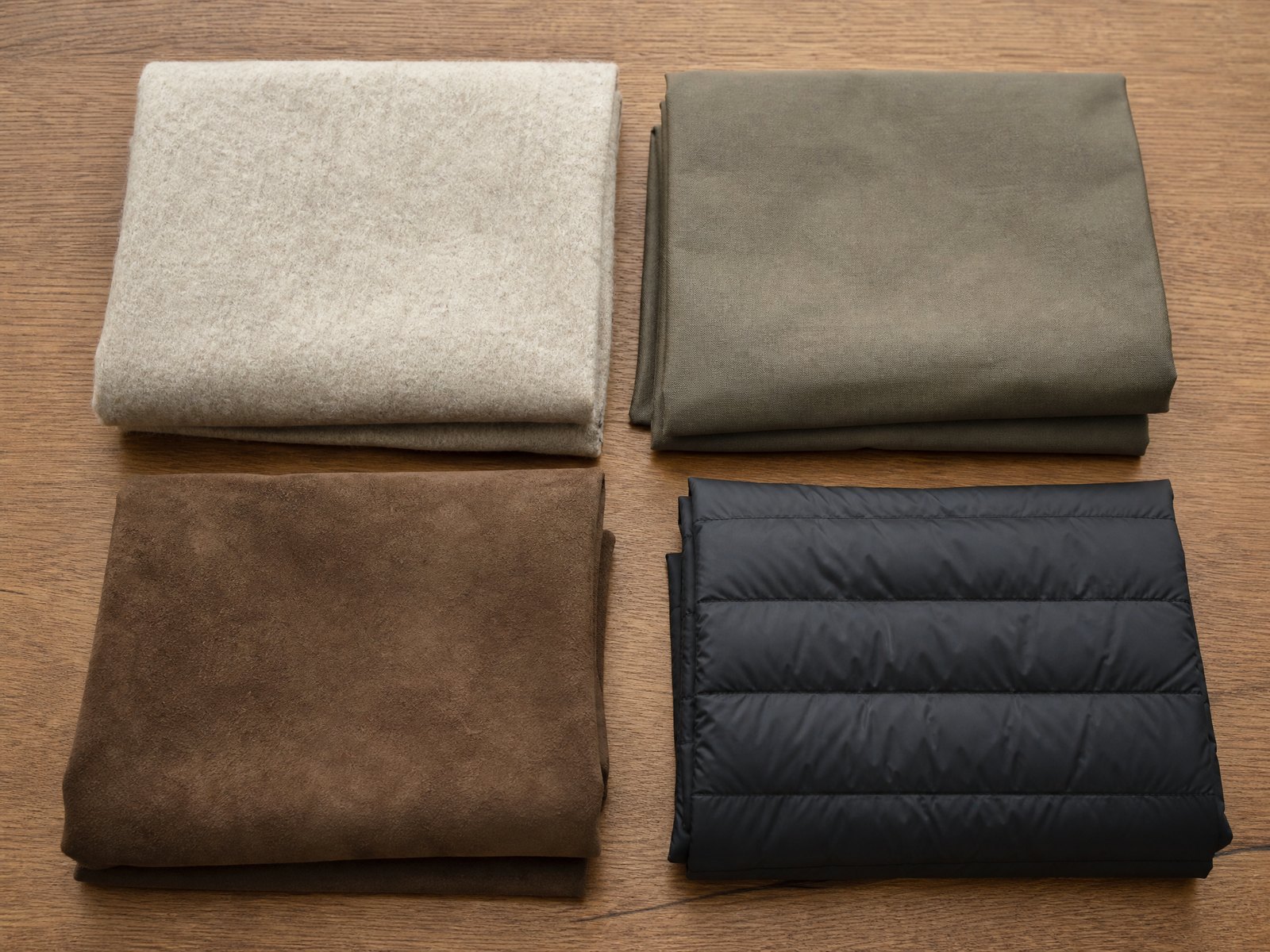
Melton is a heavily milled, densely woven wool with the surface raised and then cropped flat, so the weave disappears and you get a firm, matte face with a slightly felted hand. It is the traditional British coating cloth for good reason: it holds a shoulder line, resists wind almost completely, and does not fray at a cut edge.
We use it between 480 and 620 gsm. Below that a long coat collapses on the hanger; above it the coat becomes genuinely heavy to wear all day.
The trade-off: weight. A 620gsm mid-calf coat weighs around 2kg. It is also warmer than most British winters actually require, which is why we blend. A little polyamide adds abrasion resistance at cuffs and pocket edges; a little recycled polyester reduces weight and improves recovery from creasing. Pure wool feels better in the hand — blends survive a fifth winter looking better. We publish the exact composition on every page so you can choose.
Lambswool and doeskin
Lambswool comes from the first shearing, so the fibre tips are finer and unbroken and the cloth feels softer against the neck. Doeskin is a lighter woven wool with a smooth, close-cropped face, used for short jackets and overshirts where melton would be too bulky.
The trade-off: both pill more readily than melton at friction points, and doeskin marks with water spotting more visibly. Both take a crease more easily and need steaming rather than pressing.
Boiled wool
Knitted first, then deliberately shrunk in hot water and agitated so the fibres lock together. The result is dense, slightly spongy, and stable at a cut edge with no need for a facing — which is why boiled wool jackets can be so clean inside. It has natural stretch that woven wool does not.
The trade-off: the surface is fragile in a specific way. Press it directly with an iron and you flatten the loft permanently. It also holds moisture longer than melton, so it takes longer to dry out.
Cotton gabardine
A steep-twill weave with a very high thread count, invented in Britain specifically for weatherproof outerwear. Because the yarns are packed so tightly and the twill line is so steep, water beads and runs off the surface without any coating at all. It breathes, unlike a laminated waterproof.
We use gabardine from 260 to 320 gsm, sometimes blended with polyester for crease recovery.
The trade-off: gabardine is water-repellent, not waterproof. In an hour of steady rain it will eventually wet through at the shoulders and the belt. It also creases — that is what cotton does, and part of why a trench looks better after a few seasons. Organic cotton twill, which we use for unlined trenches, is softer and lighter but repels less and creases more.
Suede
Suede is hide split and finished on the flesh side to raise a nap. We use goat suede where we want structure and a fine, tight nap, and lamb suede where we want drape and softness against the hand.
The trade-off: the largest of any material we work with. Suede has essentially no recovery — it moulds to you and stays moulded, which is a virtue over years but means a size cannot be corrected by wear. It marks with water in droplet patterns until brushed. It varies from skin to skin in depth, grain and nap direction, so two panels of one jacket can catch light differently. And it cannot be washed at home under any circumstances. What you get in return is a jacket that improves visibly for a decade, which no synthetic does.
Down and feather fill
Our down coats use duck down and feather blends, either 90/10 or 80/20. Down is the cluster from beneath the outer feathers; it traps air in three dimensions and is still the best warmth-to-weight insulator available. Feather content adds structure and cost efficiency at the expense of a little loft.
The trade-off: down is useless when wet and slow to dry, which is why every down coat we make has a tightly woven polyamide or recycled polyester shell with a water-repellent finish. Down also needs correct washing and full tumble drying or it clumps. Duck down is less lofty than goose down at the same fill weight but noticeably less expensive, and in a British winter the difference in real warmth is small.
Recycled polyester and polyamide
We use recycled polyester in down shells, some linings, and as a blend in wool coating. It is stronger than natural fibre at the same weight, holds a water-repellent finish, and resists creasing. Polyamide appears in melton blends for abrasion resistance at cuffs and pockets.
The trade-off: synthetics are less breathable and shed microfibres in the wash. We use them where the durability gain is real rather than as a way of thinning out wool content, and we never describe a blended cloth as pure.
Linings, interlinings and trims
Bodies are lined in a smooth woven lining — viscose-based where we want breathability against knitwear, recycled polyester where we want durability and slip. Front edges and collars carry a woven interlining so lapels roll rather than crease. Pocket bags are cotton-rich twill. Buttons are corozo or horn-tone polyester with a shank; zips are branded metal or moulded plastic depending on style.
Wool, and the temperature question
People often assume a heavier coat is always better. In practice a 500gsm wool coat over a fine jumper is comfortable from roughly 12°C down to 2°C. Below freezing, down outperforms wool at half the weight. Above 12°C a cotton trench is the right answer and wool becomes uncomfortable. We keep all three families in stock because no single cloth covers a British year.
Full composition, fill ratio and cloth weight are listed on every product page. Questions about a specific cloth: support@masolimi.shop, or see https://masolimi.shop/materials.
MASO LIMITED
Company number 17274359, registered in England and Wales.
Registered office: 4 Capricorn Centre, Cranes Farm Road, Basildon, SS14 3JJ, United Kingdom
Email: support@masolimi.shop
MASO LIMITED is not currently registered for VAT. No VAT is charged on the prices shown on this website.